What is SEO? Complete Guide for Beginners in 2026
Este artigo faz parte do tópico: SEO para Empresas
If you have a business and want more people to find you on Google, you have probably heard of SEO. But what exactly is SEO, how does it work, and why do so many companies invest in this strategy? In this guide, you will understand everything — without unnecessary technical jargon.
What is SEO?
SEO stands for Search Engine Optimization — in Portuguese, Otimização para Mecanismos de Busca. It is the set of strategies and techniques that make your website appear in the top positions on Google (and other search engines) when someone searches for something related to your business.
Unlike paid ads, the organic traffic generated by SEO has no cost per click. You do not pay each time someone visits your site — which makes SEO one of the strategies with the highest return on investment in the long term.
How Does Google Decide Who Appears First?
Google uses a complex algorithm that analyzes hundreds of factors to decide which pages deserve to be in the top positions for each search. The process occurs in three stages:
- Crawling: Google bots crawl the web following links and discovering new pages. If your site has technical errors that block this crawling, your pages simply do not appear in the results.
- Indexing: after crawling, Google analyzes the content and decides if the page deserves to be included in its index. Shallow, duplicate, or low-quality content tends to be discarded.
- Ranking: with the page indexed, the algorithm ranks it for each relevant query based on relevance, authority, and user experience.
Understanding these three stages is crucial because a problem in any of them undermines the results of the other two. It is of no use to have the best content in the world if Google cannot crawl or index your site.
The 3 Pillars of SEO
1. Technical SEO
Technical SEO ensures that Google can crawl and understand your site without obstacles. The main points of attention are loading speed, URL structure, HTTPS certificate, sitemap, structured data (Schema.org), and proper functioning on mobile devices.
Google uses Core Web Vitals — metrics of speed and visual stability — as a direct ranking factor. Slow sites lose positions, regardless of content quality.
2. On-Page SEO
On-page is the optimization of the content and structure of each page. This includes choosing the right keywords, well-written titles and meta descriptions, clear heading structure (H1 → H2 → H3), and internal linking between the pages of the site.
The fundamental principle of on-page SEO is simple: each page must completely and clearly answer a specific search intent. Google favors pages that deliver exactly what the user is looking for.
3. Off-Page SEO and Link Building
Domain authority is primarily built through backlinks — links from other sites pointing to yours. Google interprets each quality link as a vote of confidence. The more relevant sites link to yours, the more authority your domain accumulates.
Link building is a medium to long-term process, but it is the factor that most differentiates sites that dominate the top positions from those that remain stagnant on the second page.
Local SEO: For Businesses Serving a Region
If your business serves customers in a specific city or region, local SEO is an essential strategic layer. The goal is to appear in geolocated searches — such as “digital marketing joinville” or “SEO agency santa catarina” — and in Google’s map pack (Local Pack).
The main factor of local SEO is the Google Business Profile (formerly Google My Business): a complete and updated profile significantly increases the chance of appearing in local results and on Google Maps when someone searches for your service in your city.
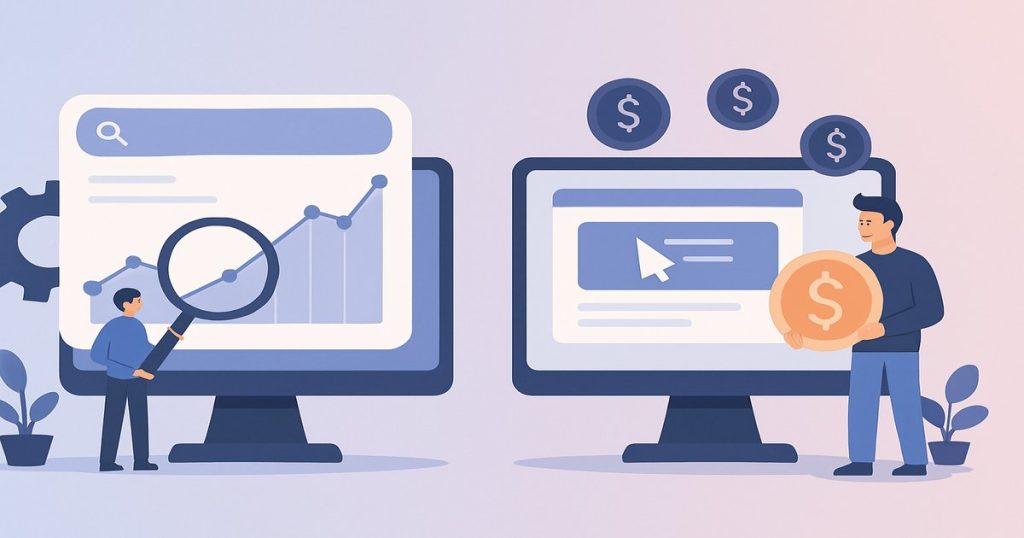
SEO vs. Paid Traffic: What’s the Difference?
This is one of the most common questions. The fundamental difference is simple:
- Paid traffic (Google Ads, Meta Ads): you pay for each click. When the budget runs out, the traffic stops immediately.
- Organic SEO: you invest time and strategy to build positioning. Once achieved, the traffic continues to come even without direct recurring investment.
This does not mean that one is better than the other — the most efficient strategy combines both. Paid traffic delivers immediate results while SEO matures; over time, SEO reduces dependence on ads and the total acquisition cost decreases.
How Long Does SEO Take to Show Results?
This is the most honest question any company should ask before investing in SEO. The direct answer: the first results appear between 60 and 90 days after the initial technical and on-page fixes. Consistent organic traffic results come in between 4 and 8 months, depending on the competitiveness of the segment and the initial state of the domain.
SEO is not a short-term solution — it is an asset that appreciates over time. Companies that invest consistently for 12 to 24 months generally build a competitive advantage that is hard for competitors who arrive later to reverse.
Where to Start with SEO?
If you are just starting out, follow this order:
- Technical audit: identify and fix the problems that prevent Google from crawling and indexing your site. Tools like Google Search Console (free) show the most critical errors.
- Keyword research: discover the terms your ideal customer uses to search for what you offer. Prioritize keywords with purchase or hiring intent.
- On-page optimization: align each page of the site with a specific search intent — title, meta description, H1, content, and internal links.
- Strategic content production: create blog articles that answer your audience’s questions and attract qualified organic traffic month after month.
- Link building: build authority with links from relevant sites in your segment consistently over time.
If you prefer to focus on the business while experts take care of the strategy, check out the Focofy SEO service — or, if your business serves a specific region, the local SEO for businesses.
Conclusion
SEO is the strategy that transforms Google into a permanent customer generation channel for your business. Unlike ads, organic positioning is an asset that grows over time and does not stop when the budget runs out. Understanding how it works — and investing consistently — is the decision that separates companies that rely on referrals from those that attract customers every day.
Want to understand how SEO fits into your strategy? Access the complete guide at SEO for Businesses or talk to our team for a free diagnosis.