
SEO vs. Paid Traffic: Which is the Best Strategy for Your Business
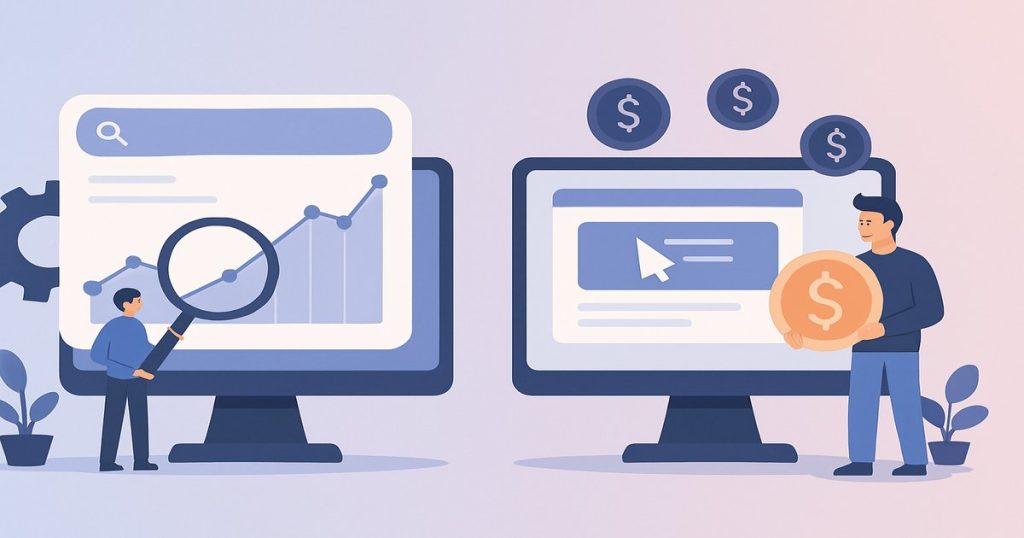
It is one of the most frequently asked questions in digital marketing: should I invest in SEO or paid traffic? The honest answer is that the question itself is already wrong — because the two are not competitors; they are strategies with different roles and distinct ideal moments.
In this guide, you will understand the real differences between SEO and paid traffic, in which situations each delivers better results, and why companies that grow consistently use both in a complementary way.
How Each Works (In Summary)
SEO is the set of strategies that make your site appear in Google’s organic positions — without paying for each click. The traffic generated is the result of relevance, authority, and technical quality of the site, built over time. See the complete guide: What is SEO?
Paid traffic consists of paid ads on platforms — Google Ads, Meta Ads, LinkedIn Ads — where you set a budget, create ads, and pay for each click or impression. The traffic starts immediately and stops when the budget runs out.
Direct Comparison: SEO vs. Paid Traffic
Cost
SEO: investment in monthly service (strategy, content, link building) with no cost per click. The cost is fixed regardless of the volume of traffic generated. Over time, the cost per visit decreases progressively as organic traffic grows.
Paid traffic: variable cost directly proportional to the volume of traffic. If you double the budget, you approximately double the visits. There is no free scaling — each click has a cost, and this cost tends to rise in competitive markets over time.
Time to Result
SEO: first results between 60 and 90 days. Consistent and growing traffic between 4 and 8 months. Larger scale results after 12 to 18 months of continuous work.
Paid traffic: immediate results — within hours of activating the campaign, you can already have visits and conversions. The problem is that the result depends on continuous optimization; new campaigns rarely perform well in the first weeks without adjustments.
Durability of Results
SEO: the organic traffic gained continues to arrive even without direct recurring investment. A well-positioned page can generate visits for years with minimal maintenance. It is an asset that appreciates over time.
Paid traffic: traffic stops when the budget runs out or the campaign is paused. There is no accumulation — each period requires new investment to maintain the same result.
Control and Targeting
SEO: you optimize for keywords, but you do not have total control over who appears in organic results — Google decides based on relevance and authority. Geographic and demographic targeting is limited.
Paid traffic: precise control over who sees the ad — by location, age group, interests, purchasing behavior, device, time, and even by existing customer list. For campaigns with a very specific audience, paid traffic is unbeatable.
Visibility on the Results Page
SEO: appears in organic results, below the ads. But in informational searches (users searching to learn, not to buy), organic results have a much higher CTR than ads.
Paid traffic: appears at the top of the page, above organic results, with a “Sponsored” tag. In searches with immediate purchase intent, ads capture a large portion of the clicks.
When to Prioritize SEO
SEO is the right choice when:
- You want to build a long-term channel: companies that rely on referrals today and want to diversify customer acquisition need to build organic presence — and the sooner they start, the sooner the asset will be mature.
- The cost per click of paid traffic is very high: in segments like law, medicine, education, and real estate, CPC can exceed R$ 20 per click. SEO eliminates this variable cost after maturation.
- You want to rank for informational content: blog articles, guides, and tutorials perform much better organically than in ads — users in the research phase ignore ads and click on content.
- Your business is local: Local SEO on Google Maps and in geolocated searches is highly effective for SMEs with low advertising budgets.
When to Prioritize Paid Traffic
Paid traffic is the right choice when:
- You need results now: product launch, seasonal promotion, event, or immediate need for lead generation — paid traffic is the only channel that works in days.
- Your audience is very specific: B2B with defined position, company, and sector (LinkedIn Ads), or remarketing to those who visited the site but did not convert — targeting that SEO cannot reach.
- You want to test before scaling: before producing 20 articles on a topic, a Google Ads campaign with the keywords validates if that audience converts. It is a quick and cheap laboratory compared to the cost of a strategic SEO mistake.
- The domain is new: sites without authority history take longer to rank. Paid traffic ensures immediate visibility while SEO is being built.
The Strategy That Works: SEO + Paid Traffic Together
The companies that grow the most organically do not choose between SEO and paid traffic — they use both with complementary roles and a budget that progressively shifts from paid to organic:
- Months 1 to 4: paid traffic to generate immediate customers while SEO is structured. Google Ads and Meta Ads finance growth while organic matures.
- Months 4 to 8: SEO starts to generate qualified traffic. The investment in ads can be maintained, but dependence decreases. The total acquisition cost begins to fall.
- After 12 months: mature SEO generates consistent traffic with a cost per visit close to zero. The ad budget can be directed to higher margin campaigns or new products, not to sustain basic traffic.
Practical Cases: Which Makes More Sense for Each Business
Medical clinic in Joinville: local SEO on Google Maps to capture searches “clinic + specialty + joinville,” combined with Google Ads for high-value specialties. Local SEO results in 2 to 3 months and has a much lower cost per lead than Ads in the long run.
E-commerce of physical products: Google Shopping Ads for immediate conversion (those searching for a product already want to buy) + SEO for categories and blog for informational traffic and domain authority. The two channels feed into each other.
B2B law firm: content SEO to rank articles on specific legal topics (qualified traffic with search intent) + LinkedIn Ads for active company prospecting. Search ads have prohibitive CPC in law — content SEO delivers the same client at a much lower cost.
SaaS or consulting with a long sales cycle: educational content SEO to attract leads at the top of the funnel + paid remarketing to impact those who visited but did not convert. SEO educates; remarketing converts those who already know.
Conclusion
SEO and paid traffic solve different problems at different times. Paid traffic is the short-term accelerator — it delivers results now, but stops when the budget runs out. SEO is the long-term asset — it takes longer to mature, but generates recurring traffic without cost per click once established.
The right question is not “which one?” — it is “how to use both in a way that the paid finances growth while the organic is built, until the organic sustains the business independently?”
Want to understand which combination makes more sense for your business’s current stage? Access the complete guide at SEO for Companies or talk to our team for a free diagnosis.

