LinkedIn for B2B Companies: How to Generate Leads Organically
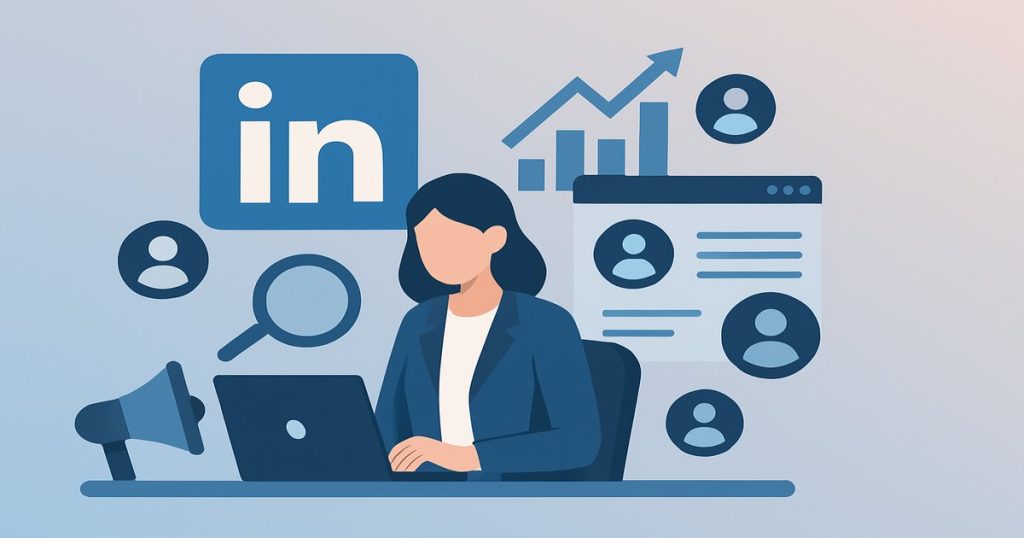
LinkedIn has over 67 million users in Brazil and is the only social network where the default context is professional. For B2B companies, this is a decisive advantage: you reach decision-makers, directors, managers, and partners in an environment where they are receptive to business content — something impossible to replicate on Instagram or Facebook.
But LinkedIn is also the network where most companies waste the most time — with corporate posts lacking personality, invasive prospecting approaches, and company pages that no one follows. This guide covers what really works to generate B2B leads organically on LinkedIn in 2026.
Company Page vs. Personal Profile: What Generates Results
On LinkedIn, personal profiles have much higher organic reach than company pages. A post from a founder or director consistently reaches 5x to 10x more people than the same content published on the corporate page — because LinkedIn’s algorithm prioritizes content from people, not brands.
This does not mean ignoring the company page. It means understanding the role of each:
- Company page: institutional credibility, social proof (number of followers, connected employees), recruitment, and base for ads
- Personal profile of leaders: lead generation, market authority, active prospecting, and real organic reach
The most efficient strategy for B2B SMEs is to invest in the personal profile of the founder or sales director as the main channel, with the company page as institutional support.
Optimizing the Profile to Generate Leads
Photo and Banner
A professional photo with a visible face increases the chance of the profile being viewed by 14x, according to data from LinkedIn itself. The banner (cover image) is free advertising space — use it to reinforce the value proposition or CTA: “I help B2B companies generate qualified leads | Talk to me”.
Headline: What You Do for Whom
The headline appears in all search results and notifications — it is the second most viewed element after the photo. Avoid just the job title (“Sales Director | Company X”) and replace it with a value proposition: “I help IT companies reduce sales cycle with content marketing | Focofy”.
“About” Section: Cover Letter for Decision-Makers
The “About” section should speak to your ideal persona, not to colleagues. Structure that works: problem you solve → how you solve it → for whom → proof (result, number, case) → clear CTA. Limit of 2,600 characters — use the first 300 to capture attention before “see more”.
Customized URL and Contact Information
Customize the profile URL (linkedin.com/in/yourname) — it makes sharing easier and looks more professional. Add email and website in “Contact Information” — many leads come through this route after seeing a post, without sending a direct message.
Content That Generates Leads on LinkedIn
LinkedIn has a different algorithm than other networks. Posts that perform well tend to:
- Start with a sentence that generates curiosity or provokes (without empty clickbait)
- Have text structured in short lines — long paragraphs are ignored in the mobile feed
- Generate comments in the first hours (the algorithm amplifies posts with high initial engagement)
- Not include external links in the body of the post — links reduce reach because LinkedIn does not want to take the user off the platform. Place the link in the comments.
Formats That Work for B2B
- Result storytelling: “Our client had X problem. We did Y. Result: Z.” Without exaggeration, with real numbers when possible.
- Counterintuitive opinion: “Most B2B companies make a mistake by doing X — and why Y works better.” Generates debate, increases engagement.
- Documents/PDF Carousels: the format with the highest organic reach on LinkedIn — PDFs with educational content (frameworks, checklists, visual guides) generate high saves and shares.
- Case studies: analysis of a competitor’s strategy or market case — positions as an expert without needing to reveal your own client data.
- Behind the scenes: mistakes made, tough decisions, internal processes — humanizes the profile and generates relatable comments.
Recommended Frequency
For consistent organic lead generation: 3 to 5 posts per week on the personal profile. Below this, the algorithm reduces your distribution. Above this, quality tends to drop and the audience notices. Commenting on posts from other profiles in your niche daily is as important as publishing — it generates visibility for audiences that do not follow you yet.
Active Prospecting: How to Approach Without Being Invasive
LinkedIn is the platform with the highest acceptance rate for cold approaches among social networks — but this is changing rapidly with the excess of automated and generic messages. A personalized approach today converts 3x to 5x more than a template message.
Connection Request
Always include a personalized note in the connection request — without a sales pitch. Mention something specific from the person’s profile, a post they published, or a common context. The goal of the connection request is just to connect — the sale comes later, after building some familiarity.
Message Sequence
After the connection is accepted, wait at least 48 hours before sending a message. The sequence that works: message 1 — thank you and reference to the context of connection (without pitch); message 2 (after 3 to 5 days) — valuable content related to the problem the person is facing; message 3 — invitation for a conversation or direct qualification question. Do not automate this sequence — personalization is the differentiator.
LinkedIn Sales Navigator
For companies with an active prospecting process and higher volume, Sales Navigator (paid plan) offers advanced segmentation filters (job title, industry, company size, recent growth), job change alerts, and InMail directly to non-connections. The investment only makes sense when there is a structured prospecting process — without it, it is an underutilized expensive tool.
LinkedIn Ads: When to Invest
LinkedIn Ads have the highest CPM among advertising platforms — between R$ 50 and R$ 150 per thousand impressions, versus R$ 10 to R$ 30 on Meta Ads. This cost is justified by the targeting: you can target by job title, hierarchical level, industry, company size, and even by specific company (Account Based Marketing).
LinkedIn Ads make sense when: the average ticket of the product/service is high (above R$ 5,000), the target audience is hard to reach on other platforms (CTOs, VPs, directors of large companies), or when the strategy is ABM focused on a specific set of target companies. For SMEs with a lower ticket, well-executed organic usually has a better ROI than paid on LinkedIn.
Metrics to Monitor
Focus on metrics that indicate progression in the sales funnel, not just vanity:
- Profile views: indicates that people are searching for you after seeing a post or receiving a connection — an increase in profile views is a sign that the content is working
- Appearances in searches: LinkedIn shows how many times your profile appeared in search results — indicates if the profile optimization is working
- Connection acceptance rate: below 20% indicates that either the targeting is wrong or the connection note is not qualified
- DMs initiated by inbound leads: the best indicator — people who come to you after seeing your content already arrive with a higher level of interest
- Meetings scheduled by channel: tracking which leads came from LinkedIn closes the loop between content/prospecting effort and business result
To understand which leads from LinkedIn really advance in the funnel, integrate with your CRM — even if it is a simple spreadsheet with the lead source noted.
Conclusion
LinkedIn for B2B is not about posting frequently — it is about posting relevantly for the right audience and systematically building relationships with potential clients. The optimized personal profile, content that positions as an expert, and personalized prospecting are the three levers that, combined, generate qualified leads consistently.
The competitive differential on LinkedIn today is simply personalization — most companies still use generic templates and corporate posts without personality. Those who treat the platform as a real relationship channel, not broadcasting, reap much superior results.
For a complete social media strategy — including integrated Instagram and LinkedIn — explore the Social Media Management hub or see how the editorial calendar can organize your content production on both platforms.