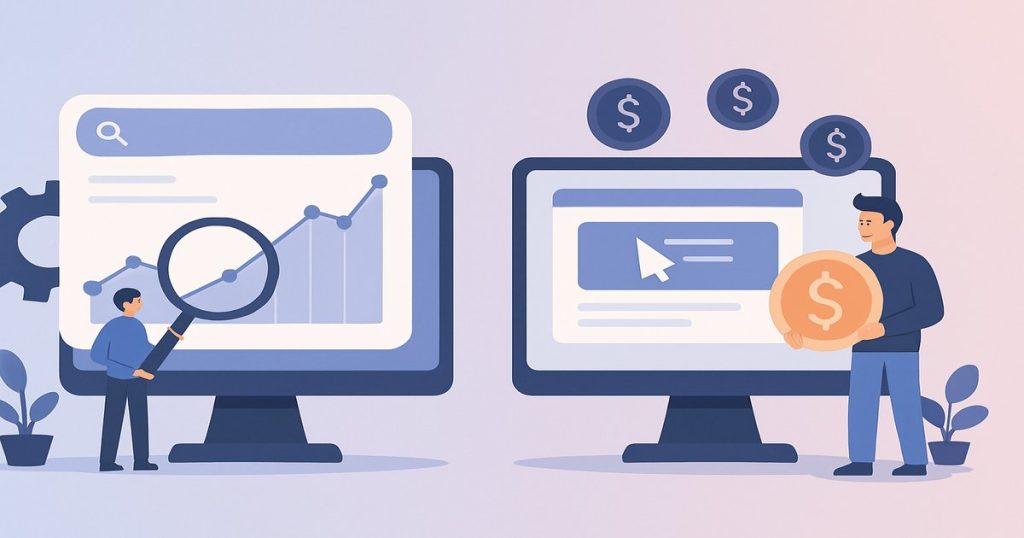
Landing Page or Website: When to Use Each in Your Strategy

One of the most common — and most poorly made — decisions in digital marketing is choosing between creating a landing page or a complete website. The wrong choice wastes budget: a landing page where there should be a website loses customers who wanted to know more; a complete website where a landing page would suffice complicates conversion with too many options.
In this guide, you will understand the fundamental difference between the two, in which situations each one delivers more results, and how to use both in a complementary way — which is what the fastest-growing companies do.
What is a Landing Page (and What It Is Not)
A landing page is a single page created with one specific goal: to lead the visitor to take a specific action. It has no navigation menu, no links to other pages on the site, no blog, or “about” section. Everything on the page points to a single CTA — filling out a form, purchasing a product, signing up for an event, or downloading material.
The logic is simple: each additional link on a page is an opportunity for the visitor to leave without converting. A landing page eliminates all distractions and leaves only the path you want them to take.
What a landing page is not: a page on your site with a complete menu and footer. Service pages of the institutional site are not landing pages — they can be optimized for conversion, but they have different structures and objectives.
What is a Website (and What It Is For)
A complete website is your company’s full digital presence: multiple pages, navigation menu, blog, service pages, about page, contact, portfolio, testimonials. It serves multiple simultaneous objectives — to inform, convert, rank on Google, build authority, and be found for different search intents.
The advantage of a website over a landing page is its breadth: it can answer the queries of those at the beginning of the journey (“what is digital marketing?”), those evaluating (“how much does this service cost?”), and those ready to hire (“talk to a specialist”). A landing page only addresses the last stage.
When to Use a Landing Page
Paid Traffic Campaigns
This is the most important application of the landing page. When you invest in Google Ads or Meta Ads, each click costs money. Sending that traffic to the homepage of the website — with a menu, multiple links, and various sections — increases the chances of the visitor getting lost before converting.
A specific landing page for the campaign, aligned with the ad message and with a single CTA, consistently has a conversion rate 2 to 5 times higher than generic site pages. In paid traffic, each additional conversion point means less budget wasted per lead generated.
Launching a New Product or Service
When you are launching something new — a course, a special offer, a service that is not yet on the main site — a landing page allows you to quickly create the page, test the offer, and measure real interest before integrating it into the complete site. The creation time is shorter (1 to 2 weeks vs. 4 to 8 weeks for a website).
Lead Generation with Rich Material
Offering an e-book, checklist, webinar, or spreadsheet in exchange for the visitor’s email works much better on a dedicated landing page than in a site pop-up. The page explains the value of the material, removes distractions, and has a simple form as the only CTA. This type of landing page is the entry point of the email marketing funnel.
Testing an Offer Before Investing in a Complete Site
For new businesses or services that have not yet been validated, a landing page allows you to test if there is real demand before investing in a complete website. If the landing page generates leads with paid traffic, the product/service has a market. If it does not generate leads, the problem is the offer — and it is better to find out with R$ 3,000 invested in a landing page + ads than with R$ 15,000 in a complete website + 6 months of SEO.
When to Use a Complete Website
SEO and Long-Term Organic Traffic
Landing pages do not rank well on Google for most keywords. Google favors in-depth content, internal link structure, and domain authority history — elements that a complete website with a blog builds over time. If the goal is to generate free and consistent organic traffic, a complete website is essential.
Multiple Services or Products
If your company offers more than one main service, a complete website allows each service to have its own optimized page. A visitor searching for “Google Ads management” may discover that you also do SEO — and the average sale ticket increases. On a single Google Ads landing page, this cross-sell simply does not happen.
Building Authority and Trust
For mid-to-high ticket services — law, accounting, consulting, specialized health — the client researches extensively before hiring. They want to see who the team is, read articles that demonstrate expertise, see success stories, and understand the methodology. A landing page does not support this research journey; a complete website does.
Long-Term Institutional Presence
A website is your company’s permanent address on the internet. When someone searches for your company’s name, the website should appear and convey credibility — even for clients who arrived through a referral and are just confirming that you exist and are legitimate. For this role, a landing page is insufficient.
The Ideal Answer: Use Both with Distinct Roles
The companies with the best digital marketing performance do not choose between a website and a landing page — they use both with complementary functions:
- Complete website: institutional presence, organic SEO, authority building, multiple services, strategic blog.
- Specific landing pages: paid traffic campaigns, launches, lead generation for email marketing, offer testing.
Practical example: a dental clinic has a complete WordPress website with pages by specialty (orthodontics, implants, aesthetics) and a blog with educational content — for SEO and trust building. At the same time, it has a dedicated landing page for a Google Ads campaign for dental implants — no menu, with before/after photos, patient testimonials, and an appointment form as the only CTA.
The website generates authority and organic traffic. The landing page converts paid traffic with maximum efficiency. Together, they cover the entire funnel.
Common Mistakes of Those Who Confuse the Two
- Sending paid traffic to the homepage of the website: the most expensive mistake. The homepage has complete navigation and multiple objectives — a much lower conversion rate than a dedicated landing page for the campaign.
- Creating a landing page and expecting it to rank on Google: landing pages without site structure, without a blog, and without domain history rarely rank for competitive keywords. For SEO, you need the complete site ecosystem.
- Using the complete website as a landing page: adding a capture form on the homepage does not turn the site into a landing page. The distractions from the menu and multiple sections remain and reduce conversion.
- Not having either: companies that rely only on social media or Google Business Profile without a website or landing page are losing search traffic and credibility with clients who research before hiring.
To understand the costs of creating each option, see the guide How Much Does It Cost to Create a Website in 2026. And to create a website or landing page with conversion as a priority from the foundation, check out Focofy’s website creation service.
Conclusion
A landing page and a website are not competitors — they are tools with distinct roles in the digital strategy. The landing page is the converter: it eliminates distractions and maximizes the conversion rate for a specific offer. The website is the asset: it builds authority, ranks on Google, and serves as a permanent institutional presence.
The right question is not “which one?” — it is “at what stage am I and what do I need now?” To quickly validate an offer with paid traffic, start with the landing page. To build long-term presence with SEO, invest in the website. When both are working, integrate the two to cover all stages of the funnel.
Want to understand what the priority is for your business now? Access the complete guide at Website Creation or talk to our team for a free analysis.