
What is Inbound Marketing? Attraction Strategy, Stages, and How to Apply It
<p>Inbound Marketing is the methodology that attracts customers with relevant content (blog, SEO, email) instead of interruptive approaches. The 4 stages are: Attract, Convert, Close, and Delight.</p>
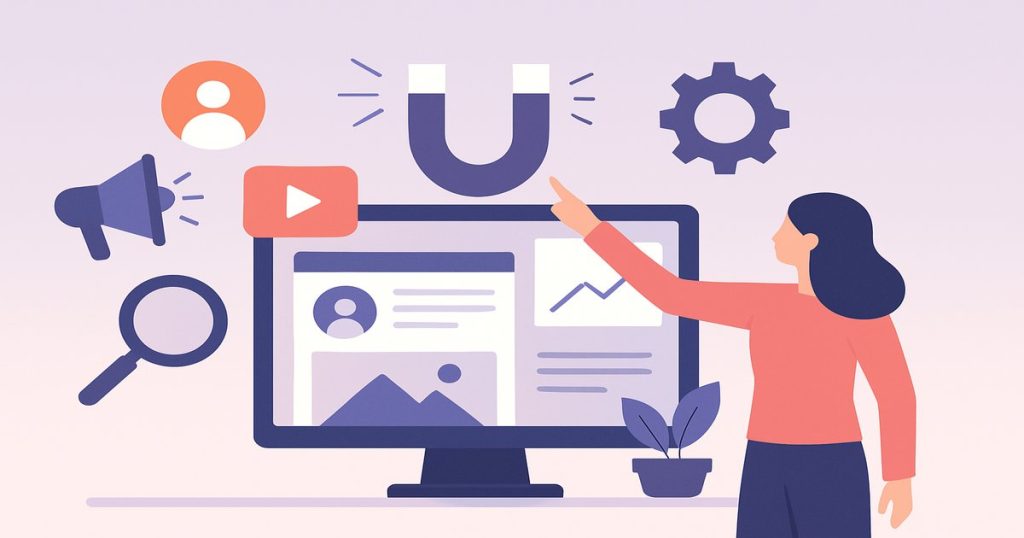
Inbound Marketing is the marketing methodology that attracts customers through the creation of relevant and valuable content — such as blog posts, videos, and e-books — instead of interruptive approaches like traditional ads. The central idea is: instead of chasing the customer, make the customer come to you.
What is Inbound Marketing
Inbound Marketing is the opposite of Outbound Marketing. While outbound interrupts the customer (TV, flyers, cold calls, pop-ups), inbound attracts them by creating content they were already looking for.
The concept was popularized by HubSpot in the 2000s and has become the foundation of modern digital marketing. The logic is simple: a customer who comes to you actively searching for a solution is much more qualified — and more likely to buy — than someone approached randomly.
In digital marketing, inbound combines SEO, content marketing, email marketing, and social media to create a journey that attracts, educates, and converts potential customers throughout the sales funnel.
The 4 Stages of Inbound Marketing
1. Attract
Bring the right customer to your website or profile — someone who has a genuine interest in what you offer.
Tools: SEO, blog, social media, Google Ads (search intent)
2. Convert
Transform visitors into leads — people who provided their contact information in exchange for something of value.
Tools: Landing pages, forms, e-books, webinars, CTAs
3. Close
Nurture the lead and turn them into a customer — with email marketing, remarketing, and a sales approach at the right time.
Tools: Email marketing, automation, CRM, retargeting
4. Delight
Turn customers into brand promoters — people who spontaneously recommend your services.
Tools: Post-sale content, support, community, referral programs
Inbound vs. Outbound Marketing
| Inbound Marketing | Outbound Marketing |
|---|---|
| Attracts those already interested | Interrupts anyone |
| SEO, blog, email marketing | TV, billboards, cold calls, flyers |
| Customer comes to your content | You go to the customer |
| Cost per lead decreases over time | Cost per lead is constant |
| Long-term results | Immediate but ceasing results |
| High qualification of leads | Low qualification |
The Ideal Strategy: Inbound + Outbound
The fastest-growing companies use both approaches complementarily:
- Inbound to build authority and capture existing demand
- Outbound (paid traffic) to accelerate results and create new demand
Benefits of Inbound Marketing for Companies
- Lower long-term cost: a blog post can generate traffic for years without additional cost
- More qualified leads: those who came through your content already understand the problem
- Authority and credibility: a company that educates is perceived as a reference
- Independence from ads: organic traffic doesn’t stop when the budget runs out
- Automatic nurturing: email automation works 24/7 converting leads
Inbound Marketing in Practice — Real Example
A HR consulting company in Joinville applies inbound:
- Attract: writes articles on “how to hire better” and “what is assessment” on the blog (SEO)
- Convert: offers an e-book “Onboarding Guide” in exchange for the reader’s email
- Close: sends a sequence of educational emails and, in the 5th email, presents the consulting service
- Delight: after the project, shares cases with the client and asks for a testimonial
Result: leads that come through the blog already trust the company and have a closing ticket 40% higher.
Related Terms
- Sales Funnel — the framework that supports inbound
- Leads — what inbound generates
- Persona — for whom inbound is built
- Copywriting — the skill that enhances inbound
- CRO — optimizing inbound conversions
- ROI — measuring the return of inbound