What is Paid Traffic and When is it Worth Investing?

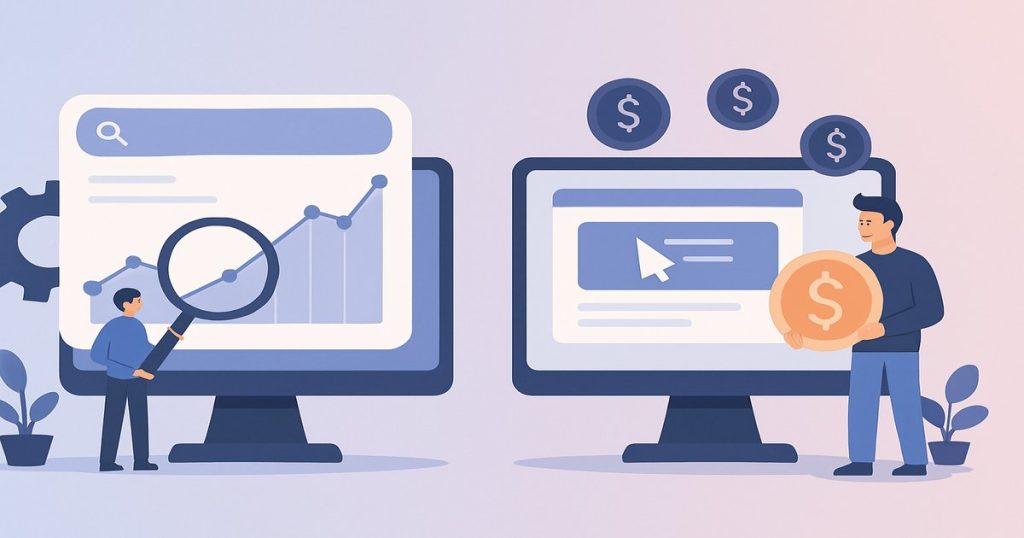
Paid traffic is any visit that reaches your site through paid ads — as opposed to organic traffic, which comes from natural Google results, social media, or referrals. The logic is simple: you set a budget, create ads on a platform, and pay for people to see or click on them.
But “simple” does not mean “easy.” Poorly managed paid traffic burns money with clicks that do not convert. When executed well, it is the most controllable and scalable channel in digital marketing. In this guide, you will understand how it works, what the main platforms are, and how to know if it is worth investing now.
How Paid Traffic Works
Most ad platforms operate on an auction system: you define how much you are willing to pay for each click or per thousand impressions, and the platform decides which ads to display based on the bid and the quality of the ad.
In Google Ads, for example, positioning does not go only to those who pay more — it goes to those who have the highest Ad Rank, calculated by the bid multiplied by the Quality Score (relevance of the ad, quality of the landing page, and expected click-through rate). This means that a well-constructed ad can appear above competitors who pay more per click.
Billing models vary by platform and type of campaign:
- CPC (Cost per Click): you only pay when someone clicks on the ad. Standard model in Google Ads and Meta Ads for traffic and conversion campaigns.
- CPM (Cost per Thousand Impressions): you pay for the number of times the ad is displayed, regardless of clicks. Common in brand awareness campaigns.
- CPA (Cost per Acquisition): you set a target value per conversion, and the platform automatically optimizes to achieve that cost. Requires a history of conversions to work well.
Main Paid Traffic Platforms
Google Ads
The largest ad platform in the world. Captures existing demand — you appear when someone is actively searching for what you offer. Ideal for businesses with products or services that people are already searching for on Google.
Main formats: Search (text in Google results), Display (banners on partner sites), Shopping (products with photo and price), YouTube (videos), and Performance Max (unified campaign with machine learning).
Meta Ads (Facebook and Instagram)
Creates demand — impacts people who were not looking for your product but are part of your target audience. The advantage is targeting by behavior, interests, and detailed demographics, including lookalike audiences based on your best customers.
Ideal for e-commerce, businesses with strong visual appeal, product launches, and any business that needs to create demand rather than just capture it.
LinkedIn Ads
The most efficient platform for B2B. Allows targeting by job title, industry, company size, hierarchical level, and professional skills. The CPC is significantly higher than on other platforms — but the leads generated have much higher qualification for corporate sales.
YouTube Ads
Video ads before and during YouTube videos. Effective for branding, launches, and products that benefit from visual demonstration. The TrueView format (you only pay if the user watches more than 30 seconds) reduces budget waste.
TikTok Ads
Rapid growth in Brazil, especially for audiences aged 18 to 35. CPM is still lower than Meta in many segments. Requires native creative — ads that look like organic TikTok content perform much better than adaptations from other formats.
Advantages of Paid Traffic
- Immediate results: within hours of activating a campaign, you can have visits and conversions. No other channel delivers qualified traffic as quickly.
- Total budget control: you define exactly how much to spend per day, per campaign, and per period. You can pause, adjust, or scale at any time.
- Precise targeting: reaches exactly the right audience — by location, interest, behavior, search intent, or similarity to your best customers.
- Complete measurement: every click, every conversion, and every dollar spent can be tracked and attributed. Data-driven decision-making is native to the channel.
- Controlled scalability: if a campaign has a positive ROAS, you increase the budget and scale the result proportionally.
Limitations of Paid Traffic
- Results when the budget runs out: there is no accumulation. Each period requires new investment to maintain the flow of visits and leads.
- Learning curve: new campaigns rarely perform well in the first weeks. Platforms like Google Ads and Meta Ads need data to optimize — and this data only comes with time and initial investment.
- Rising costs in mature markets: as more advertisers enter a segment, the CPC rises. Markets like insurance, education, and law have prohibitive CPCs for small businesses.
- Dependence on active management: abandoned campaigns deteriorate quickly. Quality, relevance, and bids need continuous adjustment.
When It’s Worth Investing in Paid Traffic
Paid traffic makes sense when:
- You need customers now: new business, product launch, seasonality, or short-term goal — paid traffic is the only channel that delivers results in days.
- Your product or service has enough margin: if the average ticket is low and the margin is tight, the cost per acquisition of paid traffic can make the operation unfeasible. Calculate the maximum tolerable CPA before investing.
- You have a clear offer and a landing page that converts: paid traffic brings visits, but does not fix a weak value proposition or a poorly structured page. Investment in ads only makes sense if conversion is working.
- You want to test before scaling: before betting on long-term SEO for a set of keywords, a Google Ads campaign quickly validates which terms convert.
The Metrics That Matter in Paid Traffic
There is no successful campaign without tracking the right metrics. The main ones:
- ROAS (Return on Ad Spend): revenue generated divided by the amount invested. A ROAS of 4 means that every R$ 1 invested returned R$ 4 in revenue. For e-commerce, the minimum viable ROAS depends on the product margin.
- CPA (Cost per Acquisition): how much you pay for each lead or sale generated. It should be compared with the LTV (lifetime value) of the customer to assess whether the investment is sustainable.
- CTR (Click-Through Rate): percentage of people who clicked on the ad compared to the total who saw it. A low CTR indicates a problem with the creative or targeting.
- Landing Page Conversion Rate: percentage of visitors who completed the desired action (form, purchase, call). If the CTR is good but the conversion is low, the problem is on the page, not in the ad.
- Cost per Click (CPC): how much you pay for each visit. It should be analyzed together with the conversion rate — a high CPC can be justified by a high conversion rate.
Paid Traffic + SEO: The Right Combination
Paid traffic and SEO are not competitors — they are complementary. Paid delivers immediate results while organic is built; over time, SEO reduces dependence on ads and the total acquisition cost decreases. To understand how to use both together, see the guide SEO vs. Paid Traffic.
If you want professional management of paid traffic for your company, check out the paid traffic service from Focofy, the Google Ads service, or the Facebook and Instagram Ads service.
Conclusion
Paid traffic is the fastest strategy to generate customers in digital marketing — and the most controllable, because every dollar invested can be tracked to the conversion. But it requires active management, a clear offer, and enough margin to absorb the acquisition cost.
The question that every company must answer before investing is simple: how much can I pay for a customer and still make a profit? With this answer, it becomes easy to assess whether paid traffic is viable — and which platform and budget make sense for your business now.
Want to dive deeper into the paid traffic strategy? Access the complete guide at Paid Traffic or talk to our team for a free diagnosis of your campaigns.