
What is Marketing? Complete Concept, Types, and How It Works in Practice
<p>Marketing is the set of strategies and actions to create value, communicate to the market, and win customers sustainably. It involves product, price, distribution, and communication — the 4 Ps of the Marketing Mix.</p>
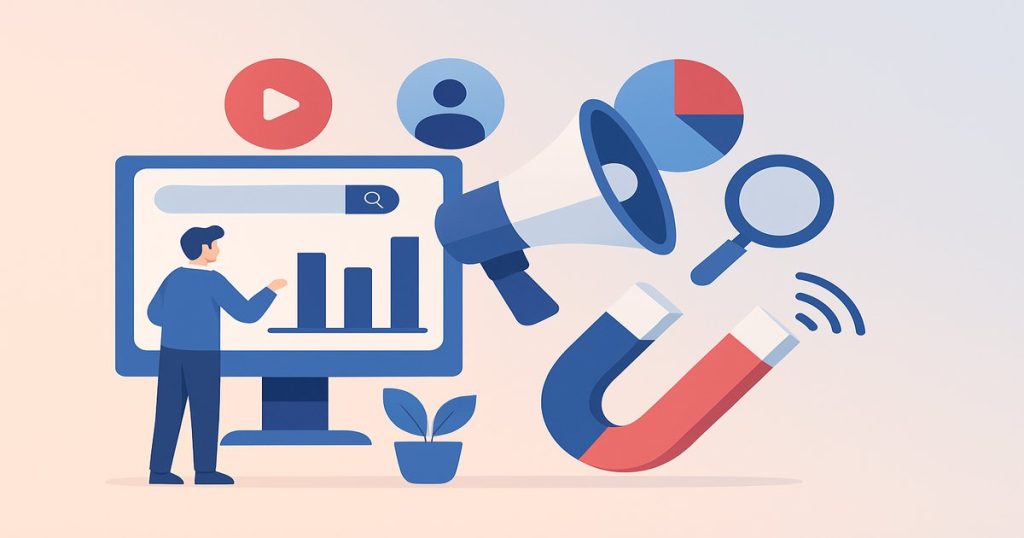
Marketing is the set of strategies, actions, and processes that a company uses to create value, communicate its proposal to the market, and sustainably acquire customers. It goes far beyond advertising: it involves market research, product development, pricing, distribution, and customer relationship management.
What does marketing mean?
The term “marketing” comes from the English market with the suffix -ing indicating continuous action — literally, “working the market.” The definition from the American Marketing Association (AMA) is the most widely used:
“Marketing is the set of activities and processes for creating, communicating, delivering, and exchanging offerings that have value for consumers, customers, partners, and society at large.”
In practice, marketing is everything a company does to understand what its audience needs and to offer a solution that they want to buy — and buy again.
In the digital environment of 2026, marketing has gained new channels and tools (Google, Instagram, email, WhatsApp), but the central principle remains: connecting those who have a problem with those who have the solution, in the most efficient and measurable way possible.
The 4 Ps of Marketing (Marketing Mix)
The foundation of modern marketing is the Marketing Mix, popularized by Philip Kotler with the “4 Ps”:
- Product: What you sell — features, quality, and competitive advantage
- Price: How much it costs — positioning and perceived value in the market
- Place: Where the customer finds you — organic Google, Instagram, referrals, partners
- Promotion: How you communicate — Google Ads, SEO, social media, email marketing
The balance between the 4 Ps defines the company’s positioning in the market. A company that gets the product and price right but neglects place and promotion is unlikely to grow sustainably.
Main types of marketing
Digital Marketing
Actions taken on online channels: SEO, paid traffic, social media, email marketing, and content marketing. It is the main customer acquisition channel for Brazilian SMEs in 2026.
Content Marketing
Creation of articles, videos, podcasts, and educational materials to attract and educate the target audience before the purchase decision.
Inbound Marketing
Strategy to attract customers through relevant content, rather than interrupting them with ads. The customer comes to the company because they found value in what it publishes.
Performance Marketing
Paid ads focused on measurable results: CPL, CPA, and ROAS. Every real invested is tracked to conversion.
Relationship Marketing
Actions to retain existing customers: email marketing, CRM, post-sale, and loyalty programs. It costs up to 5 times less to retain a customer than to acquire a new one.
Branding
Brand building: visual identity, positioning, tone of voice, and perceived value. Companies with strong brands convert more and invest less in paid media.
Marketing vs. Digital Marketing
Digital Marketing is a subdivision of marketing — specifically the actions taken on digital channels. Every digital marketing action is marketing, but not all marketing is digital.
For most Brazilian SMEs, digital marketing is currently the most accessible, measurable channel with the best ROI. Therefore, when companies talk about “doing marketing,” they usually refer to digital marketing: appearing on Google, running ads, growing on Instagram.
The complete guide to digital marketing is on our pillar page What is Digital Marketing.
Essential marketing metrics
- ROI: Financial return from each action — (Profit − Investment) / Investment × 100
- CAC: Customer Acquisition Cost — how much it costs to acquire each new customer
- LTV: Lifetime Value — total revenue a customer generates over the relationship
- Conversion Rate: Percentage of visitors or leads that become customers
- KPI: Key indicators that monitor whether goals are being met
Related terms
- ROI — Return on Investment — the main financial indicator of marketing
- Sales Funnel — how marketing moves the customer from discovery to purchase
- Lead — the contact generated by marketing actions
- KPI — indicators to measure if marketing is working
- Persona — representation of the ideal customer that guides the entire strategy
- CRO — turning more visitors into customers